Pellucid Literature
Experiments in media | Wendell Piez | XML XSLT XProc | Since 2001 and prior
Archive
Biblioscope - Greek New Testament Views
Each of five texts is displayed (in Ancient Greek) with a plot of its word roots (lemmata) showing uses and frequency, for philological analysis and thematic study.
Encoded in HTML and SVG with lightweight scripting, these pages were produced from richly encoded source
texts using XSLT 3.1 and XProc. Pages are self-contained (with their images) to
facilitate borrowing
.
Charles Woodbury's Talks with Emerson, 1890 (encoded 2015).
XML displaying in your browser with (yup) XSLT 1.0.
Some day this may fail to render: please let me know. A plain page can be provided in its place. The XML is always available.
Life After Death: A Manual by Gustav Fechner (English translation)
An edition of the English translation by Mary C. Wadsworth, with Introduction by William James, 1904. From 2011, this demonstrates a conversion pipeline starting with a plain text scan and proceeding with TEI encoding using a mix of automated and semi-automated tagging techniques.
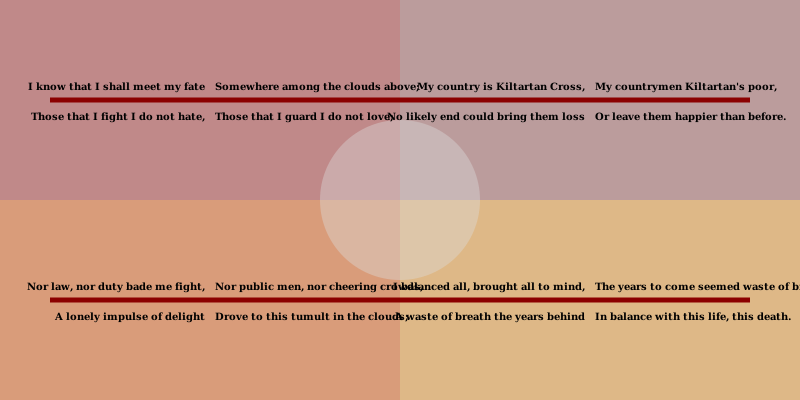
William Butler Yeats' Irish Airman, laid out programmatically
Link to the Full-blown Interactive Airman (using SaxonJS)
- Simple Airman (SVG)
- The XSLT showing the math (ye ancyente XSLT 1.0)
Jim Surkamp's Constitutional Convention, 2004
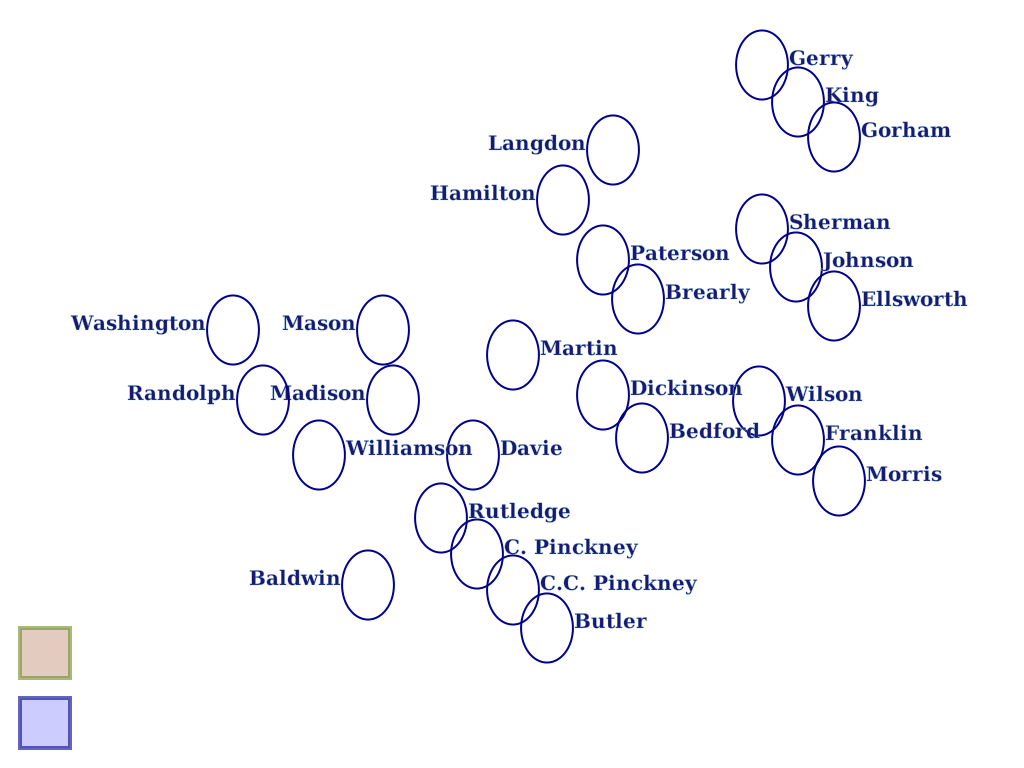
For my friend Jim Surkamp and in collaboration with him, I developed this interactive interface providing a visual-narrative, instructor-led 'backbone' for classroom discussion of the US Constitutional Convention (1787).
One of his many happy students wrote nice Powerpoint
.
The Sonneteer: a demonstration of structured form (early XML 'views' demo)
Ancient history now - a snapshot of a running XML/XSLT demonstration first developed in 2003, and still holding up remarkably well.
Die Amsel (Scholia 2002 example).
Reaching even further back, to 2002 - the original work providing the basis for more recent Scholia initiatives.
Further Afield
- XML Jelly
Sandwich offers demonstrations with a starter kit for using SaxonJS to provide browser
support for XML transformations using XSLT 3.x. Among others:
- The Electronic Verse Engineer — poetry is fun — with its older kin, the Versifier and Poem Teller
- I Ching in the browser, with local save
- Conway's Game of Life (in XSLT)
- The Laminator is my current implementation of a LMNL processing stack, used in some of these projects. LMNL is like XML, a syntax for a declarative markup language, except it permits overlap.
- Raventracks.org offers projects focused on language learning (Ancient Greek so far).
- The XProc Zone is an XProc demonstration site. It includes all its own XML, XSLT and XProc source code. If you wish to reverse engineer the state of the art (or only to learn XSLT and XProc) this might be of interest.
- My repositories on Github — are miscellaneous, certainly.
- My business web site is also due for an update.
Terrain
These projects work at an intersection. While they are specifically demonstrations of publishing technology, they are not only that or may not be, inasmuch as neither digital humanities, nor data modeling, is exclusively concerned with publishing.
Goals and non-goals
- A goal: providing access on the Internet over a longer term (years not weeks) to finished or abandoned projects in online publishing.
- These are not all technology demonstrations, or not only: some of them might be interesting as study objects or study aids.
- Not a goal: providing duplicability or replicability — but be my guest!
Strategy
Pellucid Literature is an experiment, but also an archive of prior experiments. Its
organization reflects the discovery that the proper unit of electronic publication is the
production framework or build
, applied as it may be to only a single instance
(document), or to a set of instances, whether defined actually or potentially. This is
something different from an edition, more like a series. Many of the works here can be
considered as single instances of series that are present only by implication.
Viewed as an archive, its organization is more familiar: a collection of boxes ... or maybe a collection of collections of boxes and papers mixing folders with files. In Github can be found source data for most, but not all, of the projects here offered.
Any given project may consist of a single publication, or several, or may offer an evolving aggregative ensemble. Pellucid Literature, or part of it, may not be the same from one week to the next. Or it might sit unchanged. It is designed so it can be abandoned and be none the worse for it. By reading this now, or by reading or using any work here posted, you are already realizing a best case scenario.
Principles
- Made to be sustainable and easy to support, to the extent that can be achieved by exercising prudence and foresight.
- Not just an archive: in a (metaphorical) sense Pellucid Literature is a cellar wherein we can hope to see what ages well.
- The goal is commandeer neither your machine, nor your attention, but to provide you with materials for programming or attending to, grist for your mill.
Credits and authorship
Pellucid Literature is an experiment in publishing (and a series of such experiments) by Wendell Piez. Its contents should be considered copyrighted unless and where stated otherwise. That being said, most projects here offer some kind of reuse provision, typically an open source license permitting you to reuse (and even republish) given modest accommodations such as acknowledgement.
Similarly, all works used as sources are in the public domain, or are used in accordance with their licensing terms, including terms that they be credited. In such cases please find crediting information with the project and in the repository. Since some upstream productions request that modifications or improvements be made available to them, this is offered as a general rule — unless there is some reason it cannot be, everything is available to everyone.
Best efforts have been made to acknowledge upstream contributors and if you feel anyone has been overlooked, that can be fixed. In no way should anyone suppose that such works as appear here could be made without lodes of rich source data to smelt and fashion.
The ‘content’ of any medium is always another medium. (Marshall McLuhan, 1964)